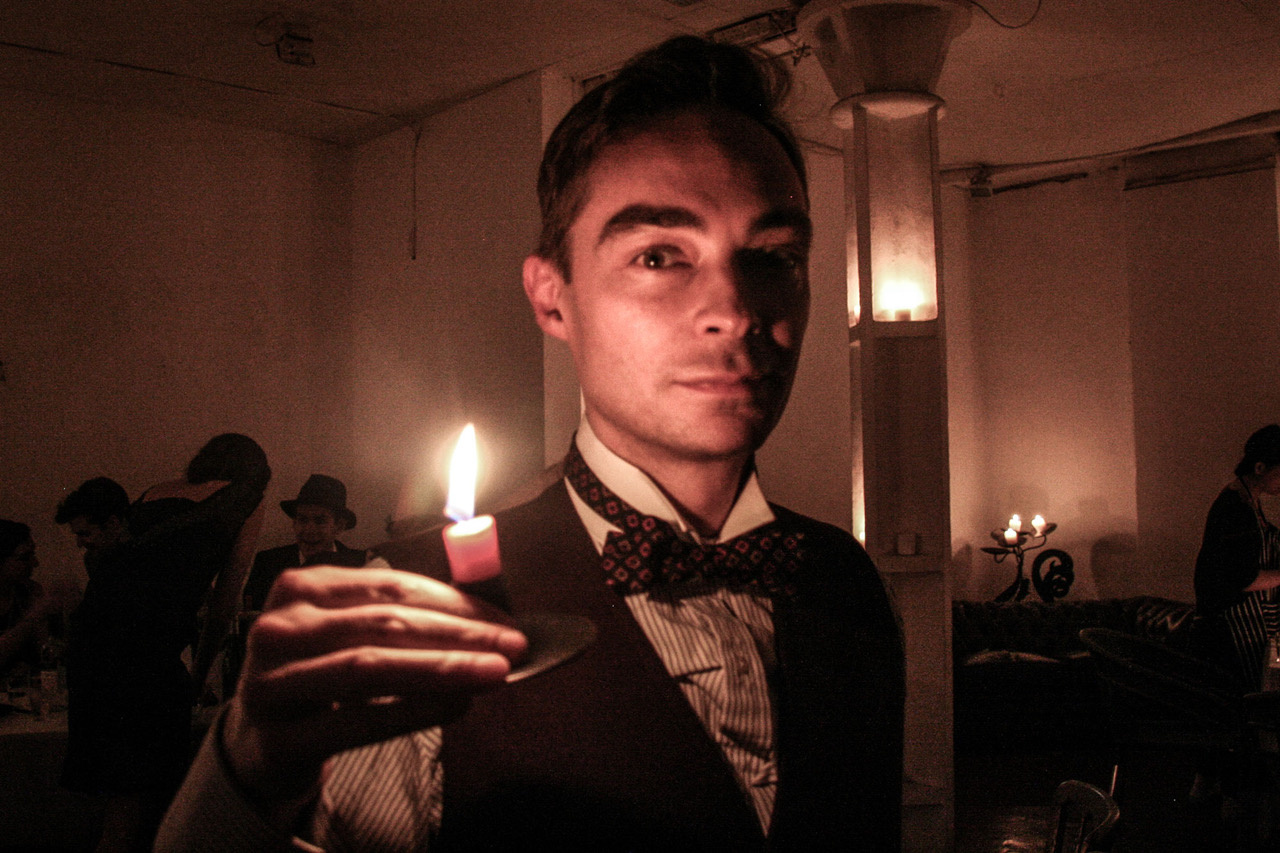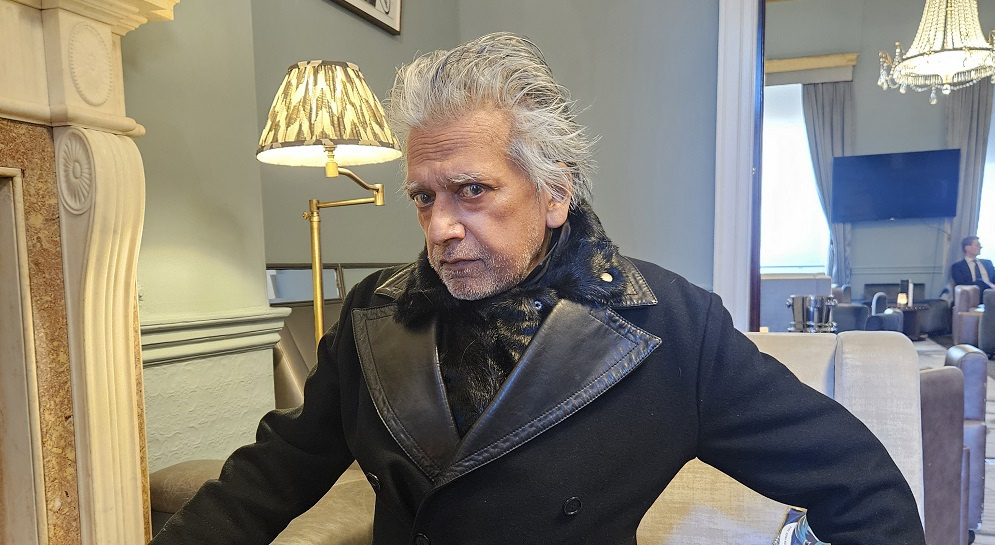
Once there was a boy who, when asked by an exasperated games master whether there was any sport on earth he might consent to enjoy, answered at once and without quite knowing why: fencing. Robin Dutt was that boy. Where the knowledge came from he cannot say - perhaps a memory of Errol Flynn, bringing drama and expression to something already halfway to the Dandiacal - but the answer was correct, and a Mr Wielebonovski duly arranged weekly sessions at a centre in North London. The grace of statuary stature, Dutt observes, goes well with the stance of the Dandy. He has been perfecting the stance ever since.
He attended a Gothic monstrosity of a school on the Marylebone Road, where he spent his hours in an almost circular library whose Victorian stained glass - legendary knights and heroes rendered in ruby, emerald and sapphire - shone like jewel-slices when the sun stood at its zenith. Alone, mostly, he kept a black book he titled International Spy, into which he pressed glass shards, cigarette butts and abandoned notes to give the whole a three-dimensional aspect. Everything was a potential story. None were developed. The idea, as he says, was there.
The lineage helps. His great-uncle was Aurobindo Ghose, the Indian poet and philosopher whose ashram still flourishes in leafy Pondicherry; his great-grandfather, the poet Manmohan Ghose, was written about by Oscar Wilde himself in the Pall Mall Gazette of the 1890s. His father made rather a name in advertising; his mother, he says, remains a talent and an inspiration, and once told him - correctly - that the book he would spend sixteen years writing was in truth his autobiography. That book is DANDEMONIUM, a purple-clothed, richly illustrated definition of the Dandy as a creature of philosophy and history quite as much as of cravat and glove. It is, he is pleased to report, complete, published, and selling.
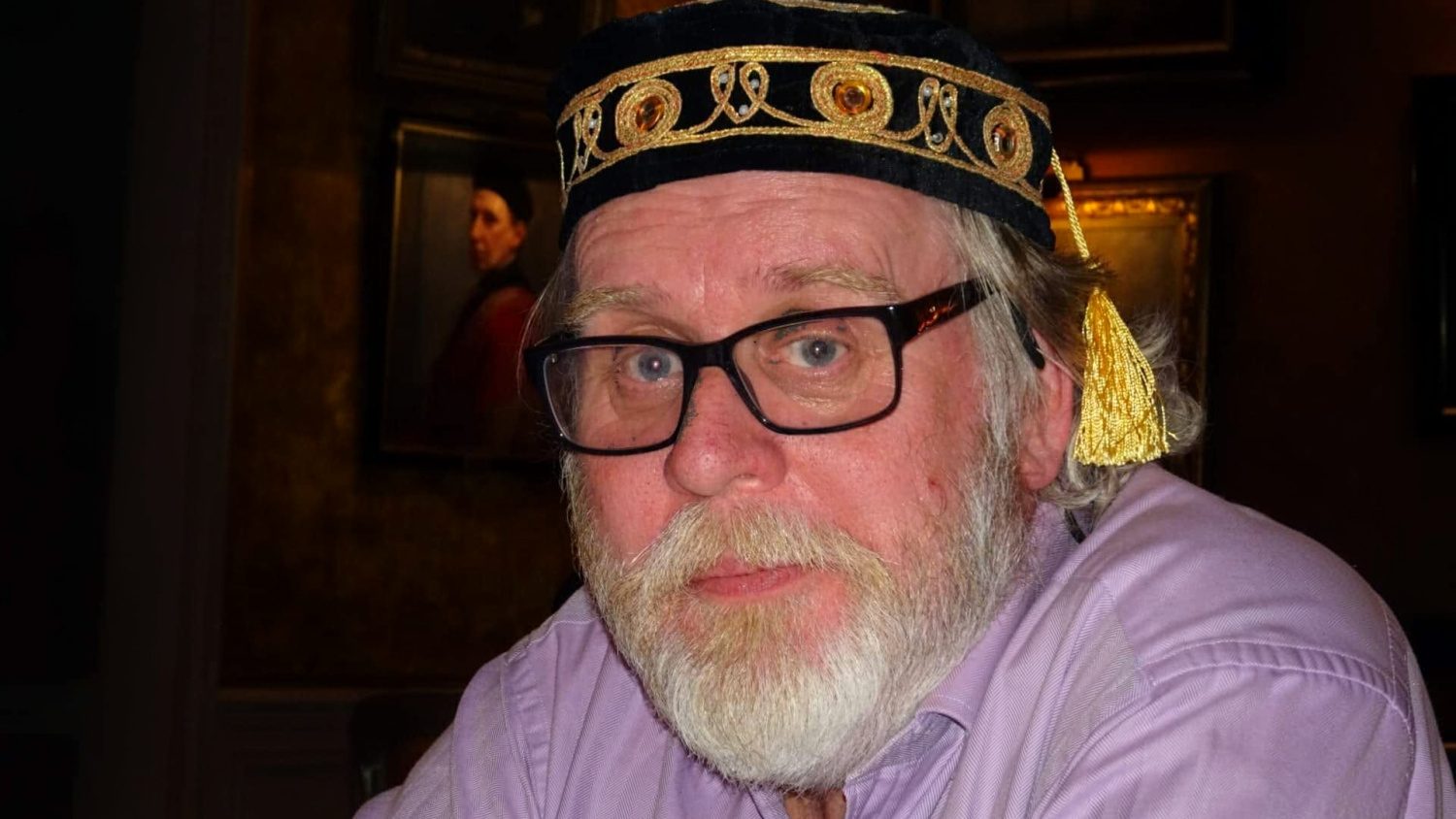
Fittingly for a man who has spent a lifetime composing his own image, he has himself been much portrayed - painted and sculpted by Howard Morgan, Sarah Stitt, Antonio Pacitti, Annette Rowden and David Remfry, and photographed by Jane England, Jon Gray, Fergus Greer and others besides. The Dandy, one notes, prefers to be the subject.
We couldn't wait to ask him a great many questions. And he opened up and answered all of them. A few answers may seem short, but none of them dull, and after all, brevity is also a talent.
Were you an eccentric boy?
I am not entirely sure if I was regarded as one.
But I was definitely a lover, one might reasonably say, of anything that was not... Concentric. Going against the grain.
So when I did not find friends - as a flame claims the lives of moths - I felt, if not knew, that there was a difference between myself and my peers.
There were friends, but few. The two I prized most for their differences are now dead - one the scion of an Austrian clothing dynasty, the other an Arsenal supporter. Essentially, isolation set the theme of my way of being, even that early, and neatly echoed what I would come to understand as the real core of Dandyism: the delicious sorrow of being a Dandy in a miasma of normality. I never felt an outsider as such, however.
Times may change. Truth does not.
Sixteen years on one book. What kept you?
I never regard Time when I think of anything. Do you ask how long a honey bee takes to build its hexagonal cells into the sweetest palaces, mathematically pure? No. So sixteen years represent nothing painfully drawn out to me. It is very difficult to quantify how a work of observation is shaped. It happens. It is. It lands, with its own wings, on a tranquil or a troubled garden - frequently both.
People might spend a whole life planning the book they will never write. And while it may be true that everyone has a book in them, unless paper or screen is involved, ideas are simply motes of dust in the breeze. The main idea is to convey passion; I hope I have done so with DANDEMONIUM, and I think I have. But believe it or not, I always knew I would write such a tome. I did not know what would fill it; the feeling for it was beyond that. It was simply that I had to. It matters little whether readers agree or reject - the latter might be the greater source of inspiration, for something. All that is in the book is all I feel. I learnt so much about feeling through the songs of Marc Bolan, David Bowie and Morrissey - and, of course, Lou Reed, Nina Hagen and Laurie Anderson. I am ever grateful to Fate herself for putting these human milestones in my path, to discover and enjoy forever.
Now. Give me the whole afternoon with Warhol - not the anecdote.
Anthony d'Offay had a supreme space just off the vulgarity of Oxford Street - a dog-leg of a gallery, comparatively small, but beautifully lit by day and night, and his name meant everything in those days. Joseph Beuys, Gilbert & George and so many others now gone passed through his treasure trove; he was a contemporary of gallery directors like Charles Waddington, Robert Fraser, Andrew Murray and James Mayor - all of them stellar, brilliant, nothing like today's media-hunting starvelings - and there was the presence, too, of Roy Miles and of Gillian Raffles, who ran the glorious Mercury Gallery on Cork Street. But when he showed Warhol, it was a triumph beyond. The show was self-portraits only - the greatest self-portraitist of all time, forget Dali - and there he was, in the spiky silver wig he called my hat. In the video of Grace Jones singing 'I'm Not Perfect (But I'm Perfect for You)', there is Andy, in one concise phrase: 'Grace is perfect.' And in a sense... so was he. If you can manufacture anything and make it all, you have everything. If you present fiction as fact... it IS.
I interviewed him as he was setting up...
There he stood, a lone, ultra-thin figure in a grand echoing white space, and it seemed somehow incongruous, for Warhol had an aura that suggested he was never alone - and yet always was.
His power of personality I had never met before, largely because he gave nothing away. He was dressed not à la Studio 54 but in near urban-combat gear - a bulletproof waistcoat over casual trousers, worn ever since Valerie Solanas shot him in 1968 and he, badly injured, survived her bullets. Sometimes I wonder whether the whole thing had been a carefully orchestrated performance - most unlikely, of course, but it would have been so very Warholian. He could not have been more charming. It was disarming, though, to meet what seemed a wise child in the body of a man. Strategically elusive - of course. At times, with his 'Oh really?' and 'Do you think so?' and 'Gee', it seemed he was interviewing me. He was no stranger to the magic aperture of the lens, nor to the power of the pen. The lens and the page do lie - but there is something in the fictionalisation of fact; it is another mind-safari. And he was always on guard: glance at any of the celebrity shots from places like Studio 54, and you will see it, the hands almost always holding on to themselves, in protection mode.
I later interviewed one of his Factory girls, Ultra Violet, and when I asked her exactly why Warhol was so magnetic, so powerful, she had no answer. All she could tell me was that he had once paint-sprayed her Chanel courts; and there was the memory of Freddie Herko, who threw himself from a window having said his death would be a gift to Warhol - though that is disputed. I don't know that one can drag in the murderous Charles Manson to explain the impossible, but sometimes, somehow, a person's magnetism is undeniable, and oh - so very dangerous, and of course fatal. Warhol called all his workers and helpers at the Factory his Superstars, and his famous line about everyone being famous, in the future, for fifteen minutes is ominous, and psychologically vital to any grasp of what a 'superstar' truly is. Witness the television drivel some mistake for diamonds. Television makes you more real than you are yourself, he said, if I recall it rightly - and watching others on a screen, silver or not, is an escape, and always has been.
On the opening night, les toutes Londres was there - curious creatures emerging from lavish Chelsea apartments and beige council blocks alike, extraordinary manses and ordinary two-up two-downs. Such was the magnetism of Warhol: a prophet of glamour and, not so curiously, of doom. d'Offay - an elegant and learned man - knew how to throw not merely a party but one that would reverberate down the art timeline, and the very air seemed charged with dollar signs.
He signed anything put before him - press releases bearing his name, postcards, scraps of paper, the arctic-white jeans of young men with shaven heads. He signed cheques on other people's chequebooks for a million dollars. His signature was currency in itself, and I imagined, even then, the multiple-signers slipping away to sell. Cynical? No. True. Warhol knew the value of Fame. Fame's the name. Fame's the game.
David Bowie, perhaps inspired by the very notion of Fame itself, went on to write one of his most famous songs about it: "Fame (fame), what you like is in the limo; Fame (fame), what you get is no tomorrow..."
He began the evening seated at a vast, excessively expensive glass-topped table, some forty international photographers and journalists thronging and snapping and scribbling around him, for to capture a star - in image or in quote - was everything. The London twilight kissed the windows; the grey-blue of the dying day gave over to a minky night; outside there were the sounds of revellers, and an Indian restaurant opposite painted a camp Brighton candy-floss pink.
And then, all of a sudden, a sound like a gunshot rang through the room.
It was the table. The sheer pressure of so many leaning, leering bodies had cracked the glass, and it collapsed in shards at Warhol's feet. He was led away ashen-faced - no more, perhaps, than usual - but in visible shock. It must have been the memory of a rampaging Solanas, whose target he once was; one thinks, inevitably, of her. Some of his own work, after all, dwells in darkness: electric chairs as jewelled icons, guns.
Darkness can shed its own especial light. Sometimes.
Define a Dandy in one sentence.
A Dandy teaches a lesson that cannot be learnt.
Was the tradition always queerer, more fluid, than admirers admit?
No. Dandyism is never about queerness. For that, historically, one must revisit the eighteenth century and see what the Macaronis, the Pretty Gentlemen, the Bond Street Loungers and the Fops were up to - and even they were not gay by decree; their effeminate display shares nothing with the stricture and structure of the Dandy.
The Dandy is an isolated, almost sexless creature who can charm both men and women but possesses neither - at least, not until he bores of them.
Consider Brummell, the originator: silent clothing, clean lines, a polished mien, at odds with the towering powdered wigs and vast lapel bouquets of his day. He decreed no perfume - only copious washing - and a good, close shave, and kept his palette to practically duo-chrome when candy pinks and parrot yellows stalked the streets. Colour can make a point. But the power of black, navy and white is stronger, more elegant... and futuristically democratic.
Which of the Dandies you knew do you still think about?
I have met a few I would call so - Bunny Roger, Sir Hardy Amies, Quentin Crisp. And those who betray Dandiacal traits without the title: Martin Fry of ABC, the superb David Sylvian of Japan, the poet Jeremy Reed - each displaying, through dress and thought, that sense of apartness essential to the spirit.
You're known everywhere as a Dandy, more rarely as a poet - yet we know you as one, with your Salons of many years' standing. Does the wardrobe get in the way?
Never. At my Poetry Salons at Home House, clothing is luxuriated in without being lavish, and yes, there have been themes. But clothing is an outward expression of internal thought, and slides easily from past to future - which is why you might find me in a genuine eighteenth-century silk-velvet frock coat one evening and a 'Baco-Foil' space-age suit the next. Searching for approval is never the remit of the true Dandy.
Sebastian Horsley, on a night with no audience - just a few acquaintances or strangers. What was he like?
Sebastian was my dear friend, and whether he played to a vast crowd, fell asleep during someone else's recitation, or simply bellowed his own often filthy thoughts, he was the unforgettable, irreplaceable Sebastian.
I visited his tall townhouse in Meard Street, Soho, and saw how spare and stripped-down everything was - the only room for colour was in the scarlet suits and glittering ties made especially for him. Though there is one memory of him in Soho naked, of an evening, and looking remarkably well-dressed.
What makes a salon work - and why do so few survive?
Inclusion is all. If someone has something to say - however counter to the moment, or even the theme - that, to me, is fine, up to a point, for words have a life of their own, and the difference of language cannot compete with the communality of human thought. Living as we do, the Salon may seem strange to many, even an affront to certain people in the highest offices, who deem it elitist. What nonsense! Long may they continue - and continue to change and develop. A group of souls in a pub constitutes a salon, given literary intent; the glories of a sparkling chamber are much the same. Intent is all.
What does Home House give a writer that Highbury cannot?
Home House is a natural hub. That it is so grand and ancient - the 1770s, no less, and the work of the marvellous Robert Adam - means the eighteenth-century aesthetic still holds its validity amid the hustle. People speak of places where time stands still. Home House moves on, yet also stands as a sentinel of a glorious, rich and radiant past, from the apple-green walls to the gilt surrounds, the plasterwork and the wonderful floorboards, which occasionally timber-speak of times past and herald times to come.
Whose reputation would you most like to rescue?
Does anyone truly need their reputation rescued? You can be a Bluebeard, you can be a Keats; rest assured someone will find you insufferable. Reputation is in constant flux, springing from somewhere and going, perhaps, nowhere. Time and circumstance deal with all - eventually. But if I had to, the answer would be predictable: someone never appreciated in their lifetime - and there are more of those than one cares to think about. This puts me in mind of that vintage photographer who took thousands of street pictures of New York, was never known, and came - like a late-flowering bloom - to be loved at last. It rather proves my point that I cannot recall her name. [Ed: Robin is probably talking about Vivian Maier]
The most eccentric thing you've ever done?
Being an eccentric. Valuing individuality, against all odds. I could divulge journeys into the unknown, or with unknown people, but I regard these as one might the veins in a hand - paths crossing or not crossing, but there all the same. The back and front of the hand show a certain map-mimicry.
Your family, in a paragraph.
My family is indeed special. My great-uncle was the celebrated poet and philosopher Aurobindo Ghose, still the cornerstone of the ashram he founded in flowery Pondicherry. My great-grandfather, the poet Manmohan Ghose, was written of by our own Oscar Wilde in the Pall Mall Gazette of the 1890s. Then there was my Papa, who became rather something in advertising, and my sainted Mama, still such a talent and inspiration.
Your view of eccentricity as an English speciality?
Eccentricity will always, I believe, be seen as enduringly English. Anything else seems a sham.
I once knew a handsome Parisian count who dressed in hunting pinks almost constantly and whose favourite rendezvous with his girlfriend was a churchyard - quite what they got up to I know, but couldn't possibly tell. We took tea at Soho's Maison Bertaux to discuss art and style; he covered his already pale face with white powder. Such a Dandy! The son of a diplomat, I believe.
A time machine - would you use it? Which century, and dressed how?
Unnecessary - I am here today, yet inspired entirely by the glory of the Georgian age, from George I to IV, and the Regency above all. It seems the very beginning of modern thought: new literature, music, fabrics, philosophies, politics. Though Life has a way of reminding us of mortality. Look at the young George IV - an Adonis who later wolfed capons and slaked his thirst on claret and died too young, literally larger than Life. Can we learn from others' mistakes? Do we want to? They say the air is free; and so are mistakes. They sculpt, in part, who we are, and I am grateful for them.
Three wishes from a genie.
There is an old joke. A man finds a lamp, rubs it, and the jinn appears in velvet and jewels, granting three wishes. The man asks for a bottle of Guinness. 'And the other two?' asks the genie. 'Two more of those,' he says, sagely. In my own case... I would keep the genie waiting. Perhaps for a typical English rainy day.
A word of advice - to your younger self, or our readers.
Always be yourself. First, and forever. Try anything else, and you will be a sham and a fake.
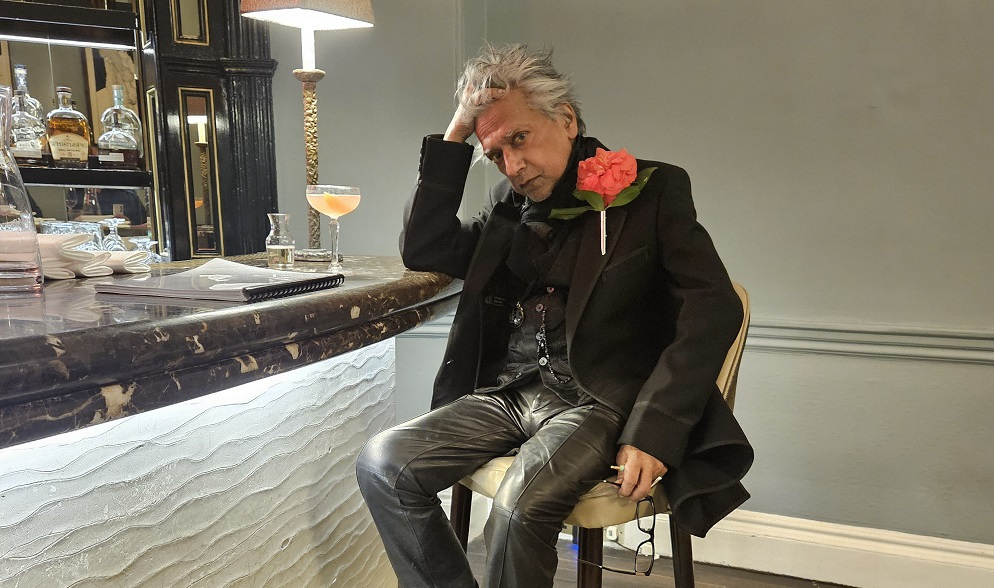 Paul Newberry
Robin Dutt is an author, journalist, stylist and lecturer whose work has appeared in The Daily Telegraph, RA Magazine, Galleries Magazine, Art Line, The Independent, the Evening Standard, Elle, Polo Magazine, GQ, Esquire and Savile Row Style, among many others. He has curated numerous exhibitions of painting, ceramics, sculpture and drawing, and written catalogues for the Coutts Contemporary Art Awards and for galleries including Waterhouse & Dodd and the West Soho Gallery, which he co-founded. His DANDEMONIUM - The Dandy Defined is published by Kerseymere, and his Poetry Salons continue at Home House. He remains, to the Eccentric Club, the dearest of friends and the most decorative of non-members.
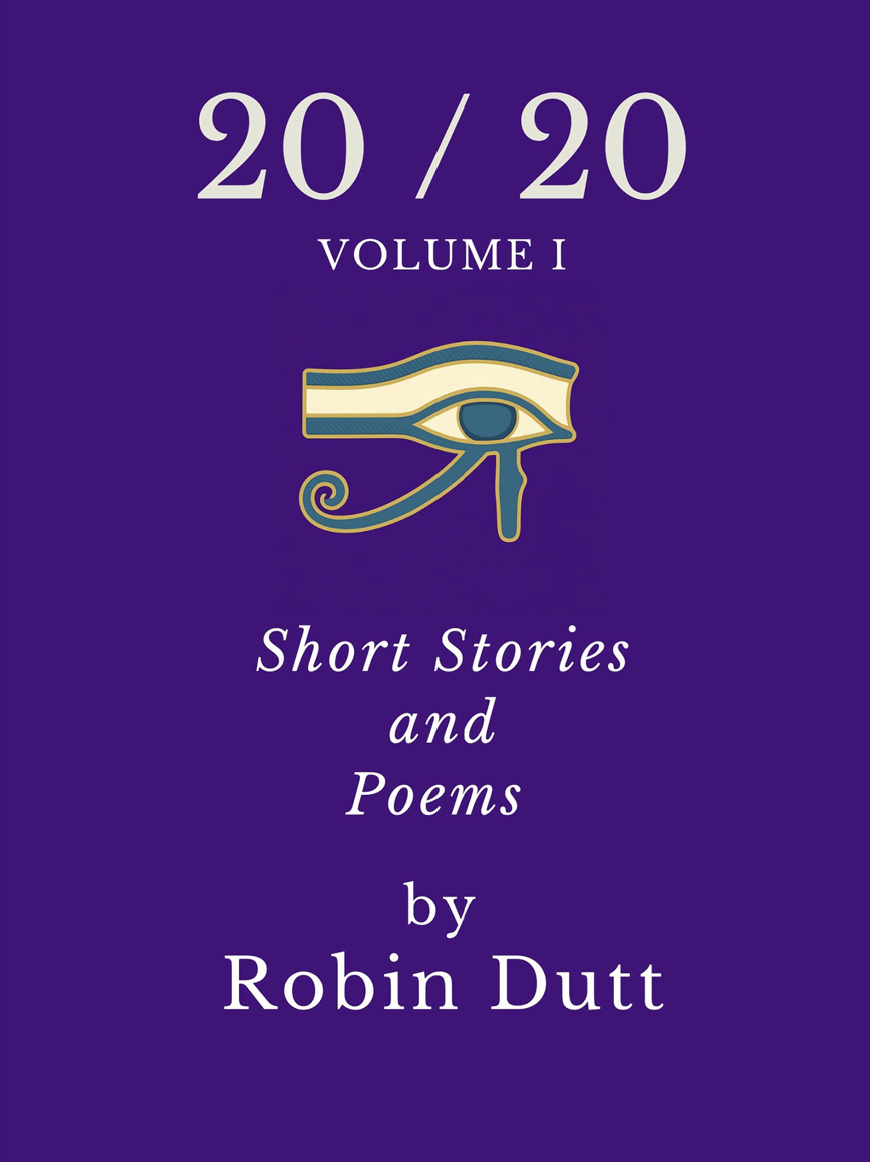
Robin has kindly offered our readers a free download of his latest book of short stories and poems, "20/20" Volume 1, in exchange for subscribing to his mailing list.